The duckweed riddle: when wrong models give right answers
March 23, 2026
Shane Frederick’s Cognitive Reflection Test — one of the most widely used measures in behavioral science — poses three questions designed to see if you can override your gut with deliberate thinking. The third goes like this:
In a lake, there is a patch of lily pads. Every day, the patch doubles in size. If it takes 48 days for the patch to cover the entire lake, how long would it take for the patch to cover half of the lake?
Most people say 24. The “correct” answer is 47. If the patch doubles daily, then one day before full coverage it’s exactly half. System 1 gives you the midpoint; System 2 catches the exponential. This is why we underestimate compound interest, why pandemics surprise us, and why retirement calculators feel like they’re lying.
T-1. Riddle solved. Exponential growth is sneaky.
Except there’s a problem.
… Duckweed doesn’t actually grow like that
The riddle assumes pure exponential doubling — every cell of duckweed produces one offspring per day, no matter what. But real duckweed grows on a real pond. It spreads spatially. A duckweed frond can only reproduce into adjacent open water. Once a colony is surrounded by other duckweed, it’s stuck. It can’t magically teleport offspring to the far side of the pond.
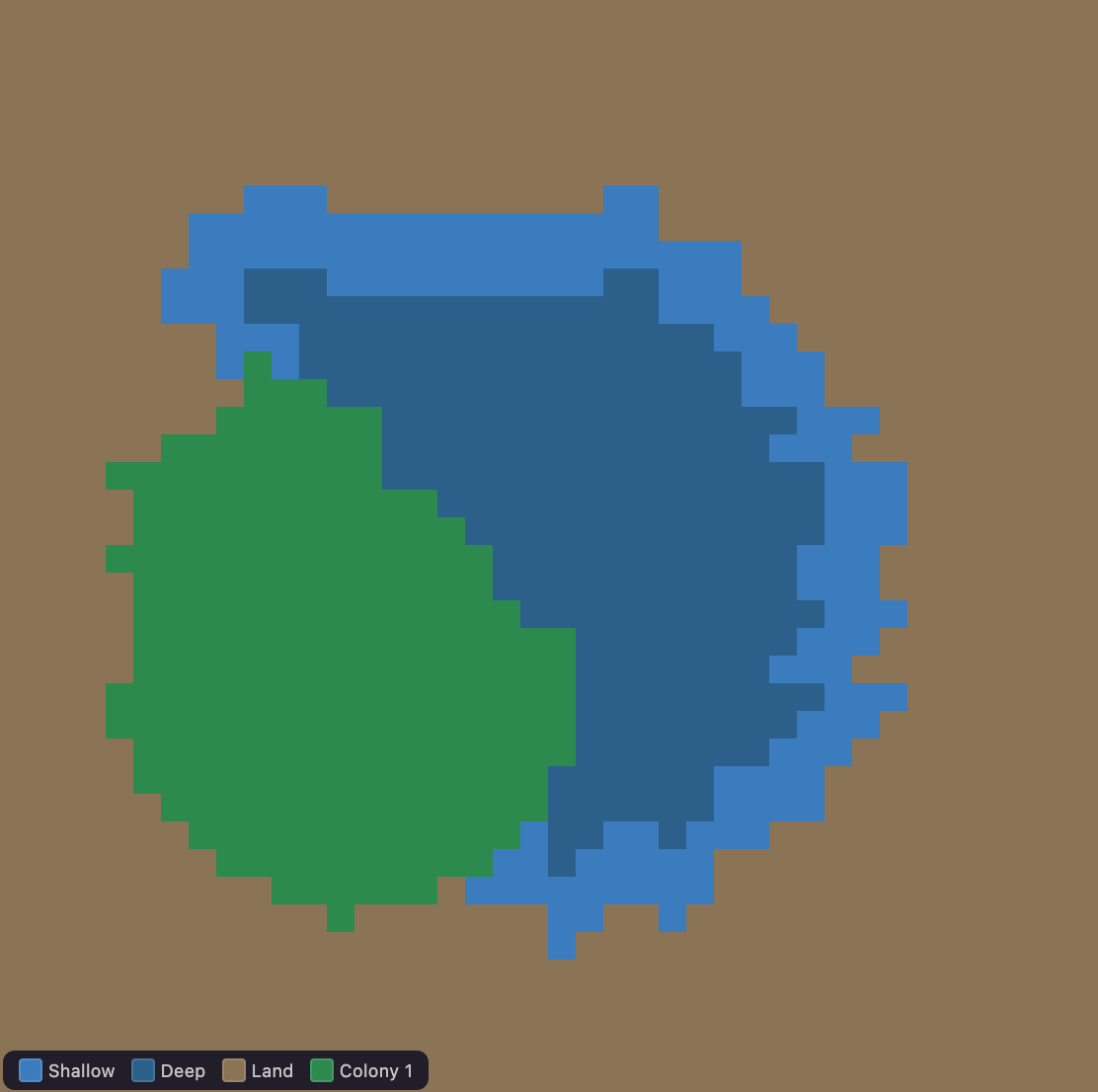
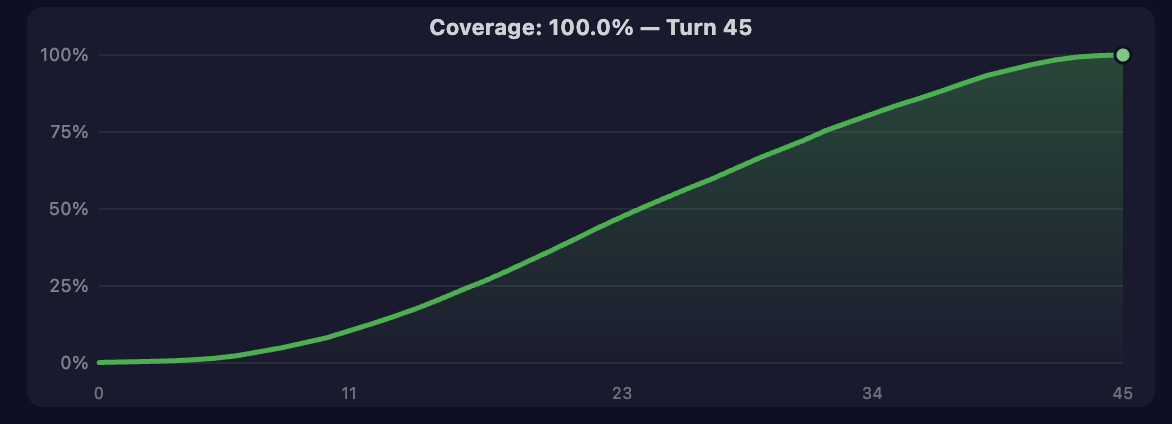
This changes the growth dynamics fundamentally. Early on, when colonies are small and surrounded by open water, growth is roughly exponential — every frond has room to expand. But as coverage increases, more and more fronds are hemmed in by their neighbors. Growth slows. The final stretch, filling in the last gaps and corners, takes disproportionately long.
The growth curve isn’t a clean exponential. It’s a logistic — fast in the middle, slow at both ends. The shape of the pond matters. The placement of colonies matters. Geometry imposes constraints that the textbook riddle ignores entirely.
You can see this for yourself in the interactive duckweed simulator. Place a colony on a procedurally generated pond and watch it grow. Or run 100 simulations at once and look at the statistics.
So the classic riddle is built on a false premise. Duckweed doesn’t double every day. The model is wrong.
The double double cross
Here’s where it gets interesting. Run those hundred simulations and look at the ratio: what fraction of total time does it take to reach half covered?
It’s remarkably close to half the time.
In the spatial simulation, with all its messy geometric constraints, the half covered mark typically falls somewhere around 50-65% of the way through total coverage time. The exact numbers depend on pond shape and colony placement, but the basic insight holds: the second half takes roughly as long as the first. The linear estimate turns out to be closer to the truth than the exponential one.
The “clever” answer (T-1) is further from reality than the “naive” one (T/2). The people who said “half” were closer all along.
Simple heuristics that make us smart
Gerd Gigerenzer calls these “fast and frugal heuristics” — simple rules that work surprisingly well because they’re adapted to the structure of real environments. He calls this ecological rationality.
The duckweed riddle is a small example. “Halfway happens around the middle” is the naive heuristic the CRT is designed to make you feel foolish about. But pure exponential growth almost never describes how things actually spread. Populations hit carrying capacity. Diseases encounter immunity. Fires run out of fuel. Real growth is logistic — fast in the middle, slow at the edges.
In that world, the linear heuristic works. Not because people understand logistic curves, but because their default assumption — things grow at a roughly steady rate — is better matched to reality than the mathematically precise but ecologically wrong exponential model.
The next time someone makes you feel foolish for thinking linearly, ask: what does growth actually look like in this environment? Sometimes the naive heuristic isn’t naive at all.